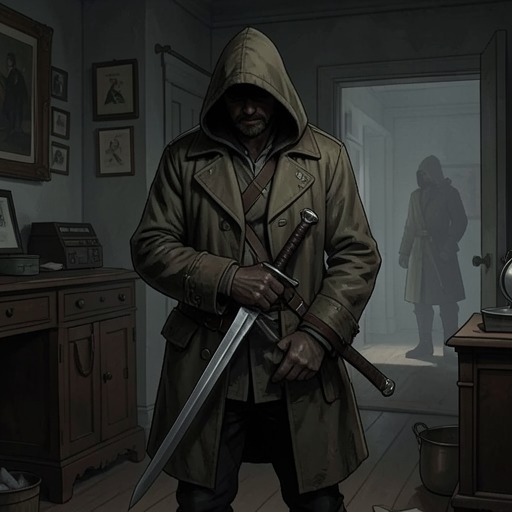
“Do you know where you are going when you die”
Heart of the HunterThe question “Do you know where you are going when you die?” frames the encounter with Marion Dorffling as more than an attack: it turns impending death into a direct challenge, a test of whether the enemy will meet his fate face to face. Its return, altered after Dorffling’s death, makes the words both a personal ritual and a structural refrain in the scene.
The Question as Challenge
The speaker asks the question when the two men are only minutes from St Michel Métro station, in the crush of a carriage. He leans close to the American, his lips nearly touching the man’s ear, with an intimacy likened to that of lovers. The contrast is deliberate: a question about death is delivered at almost tender range, while the crowded public setting leaves the coming confrontation enclosed between the two men.
The question also announces that the speaker knows whom he faces. After asking it, he names Marion Dorffling and makes clear that he has accepted the assignment and studied the dossier. The words therefore carry both a personal threat and the assurance of preparation: this is not a chance encounter, but the opening declaration of a chosen confrontation.
Mortality and the Warrior’s Calling
The question gains force from the speaker’s own understanding of death. In the brief silences between the waves of sound, he imagines returning to the voices of his ancestors, a lineage that is at once his source and refuge. He accepts that his own life will end when the blade reaches him, and imagines that final return as part of the same rhythm of silence and violent noise.
His manner of asking reflects that acceptance. He waits calmly for Dorffling to turn, wanting to see the enemy’s eyes and meet him in direct confrontation. The encounter stirs his body into battle: his heart races and the force of war rises in him. The question thus marks the threshold between considered knowledge of the assignment and the physical, instinctive state of combat.
The Refrain After Death
After Dorffling’s life fades, the speaker returns to the question in a shortened, altered form, asking where the dead man is going and whether he knows. The shift comes after the encounter has settled into stillness: the speaker lowers the body gently, wipes the assegai on the man’s T-shirt, and slides it back into its scabbard. He then turns away.
The repeated question binds the scene’s beginning to its end. Before the attack, it demands that Dorffling face the possibility of death; afterward, it becomes a final address to someone who can no longer answer. Its recurrence gives the killing a ritual shape without softening its finality: the intimacy of the opening gesture persists, but the living exchange has become a one-sided farewell.